
PART 8 – IMPROVEMENT
"Do something, it may be nothing, but it may not."
Improvement
‘The Moral Compass’ and recognising moral improvement as an ongoing process.
Practical Application
If you seek moral improvement, then a study of the lessons and wisdom of those who have gone before you is worthwhile; bearing in mind that moral improvement is not a destination but a continuous journey. Overarching principles are easily contrived; however, the difficulty is in the detail and in applying this to your personal situations (and the effect of external influences).
Moral improvement is based on goodwill and compassion directed towards the objects of our morality which may be:
one’s parents,
spouse and family
friends
all other beings
the world around us
Our moral improvement requires a conscious decision to act based on where you are (morally) and where you want to be. The following steps to improved morality are provided as a guide or suggested path for you to seek improved moral being. The steps are:
· Step 1 - Recognize morality
· Step 2 - Make a self-assessment
· Step 3 - Determine an end-state
· Step 4 - Commit
· Step 5 - Act
The steps are presented in a linear progression; however, they need not be followed in any order and are really a continuous process of recognizing, assessing, and acting.
Step 1 – Recognise morality
Morality in most of its guises is easily recognised; however, some review and discussion assists with informed decisions of how to improve your morality. A refreshed perspective better positions you to evaluate the difficult moral decisions that often present themselves. Your aim is to have a greater understanding of the issues faced and how to deal with them. Lastly, a review of morality can assist with scope and reference points for self-assessment.
Morality in both action and decisions exists within ‘The Three Precepts.’ These in turn present themselves or are manifested in more recognisable forms of our behaviour. These behaviours can be grouped into ‘like’ parts which are presented as ‘The Particulars.’ The flow from ‘Precept’ to ‘Particular’ is neither perfect nor complete, but rather as a generalised guide to assist understanding.
Table X - Recognizing Morality
Part 1 through to Part 3 of ‘TODAY’ deals with morality from the perspective of ‘The Precepts’ and provides a basis for understanding morality. Further reading and discussion from multiple sources should be undertaken to achieve a diversity of points of view. There is no correct doctrine on ‘what is morality’ but rather, subjective points of view. A study of moral doctrine is worthwhile but only to the point where the same concepts are seen repeatedly. At some stage, theory must acquiesce to action. Upon achieving greater awareness of morality, the logical next step is to look at oneself.
Step 2 – Make a self- assessment
’Part 4 – Self’ and ‘Part 5 – The World Around Us, as well as ‘Part 7 – Reflection’; of ‘TODAY’ are useful as a background to self-assessment. The ‘Relational Model’ used in PART 2 – Perspective can be used to scope a self-assessment. The level or placement within a scale or point of reference is up to you as the person doing the self-assessment. One of the aims of Step 1 is to assist with self-assessment.
The table below is based on ‘The Relational Model’ with columns added with suggested subjects (plus and minus) as a basis to doing a self-assessment. The table can be used to assess the occurrences you experience and the intensity within each of the plus and or minus subjects.
Table y - Morality Self Assessment
Whether you use the above table or not, the outcome is how you feel about your morality and your perception of a need to improve or not.
Step 3 – Determine an end state
Step 3 is a determination and statement of your desired moral state. It is where you want to be with regards to your Persona, Character, Actions and Outcomes. This is different for everyone and may range from enjoying life morally to living for a moral outcome.
There is no emphasis on where you should be within this range, but rather an effort for continuous improvement and self-reflection. As this step is personal, minimal guidance or assistance is offered. You must decide where you want to be morally. Listing items for improvement and items to discontinue provides some help and the table below follows on from Step 2 where the ‘Improve’ and ‘Cease and desist’ columns can be used to list potential changes to your current thinking or actions.
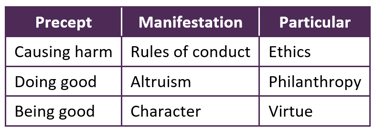
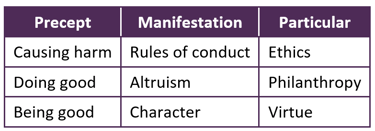
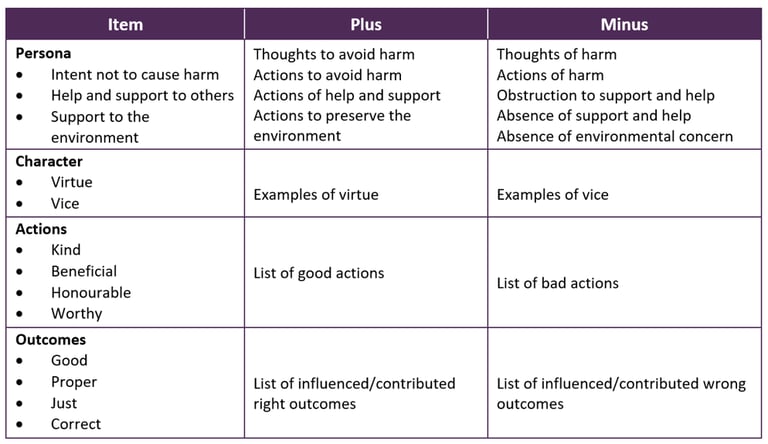
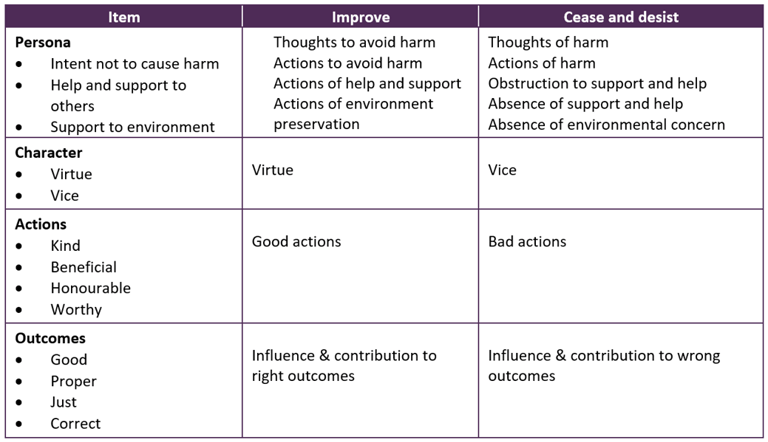
Table z - Morality End State Table
Step 4 - Commit
Commitment is an emotional dedication to a desired end state. A moral improvement commitment is a decision, with emotional attachment to your achieving a level of improved mortality.
A commitment may be internalised and not shared. The advantage of making an undeclared commitment is that it provides freedom from judgement and fear of failure. It may also be publicly declared. The advantage of making a declared commitment is that it inspires achievement through wanting to be seen as succeeding as judged by others. Support and assistance can be solicited from others who are aware of the declared commitment. A publicly declared commitment is a positive moral action that inspires others to make a similar commitment. It also fosters association of persons of similar commitment. Part 7 – Reflection of ‘TODAY’, provides an example for making a public declaration for commitment to a moral life.
Whether or not you make a private or public declaration, what is important is making and maintaining a commitment.
Step 5 - Act
By the time Step 5 is reached, you should have a good understanding of morality, self-assessment, and an idea of your desired end-state. Having come this far you should also have commitment. Once these are complete, the time for action has arrived! Act, but in a considered manner, as thoughtful acts are the ones most likely to achieve success.
Your action on improved morality need to be based on:
Accepting ethical frameworks.
Undertaking purposeful and ad hoc acts of kindness and goodness.
Growing your virtues and denying vice.
Seeking council and advice (feedback) on moral conduct and acting accordingly.
There are forces that will work against your moral actions. To deal with these, the following will assist:
Wisdom
Insight – (particularly into what we see, hear, and are told).
Awareness – (particularly of prejudice, subjectiveness, commissions, others’ motivation).
Mindfulness – (attentiveness to external goings on).
Balance – (avoidance of fanaticism and extremism).
Commitment
Effort – (to keep going).
Objectivity – (to balance vice and corruption).
Concentration – (as applied to problem solving and reaching goals).
Association – (to inspire - to be inspired - to avoid temptation and to avoid negative influence).
This is not to say that morality is only for the wise and the committed, but rather to say that thinking wisely and being committed is supportive to desired moral outcomes.
Actions to improve moral existence are different for everyone. Some of this is personal, but for others the difference will come from external influences such as:
Beliefs.
Laws.
Politics
As such, there is little to be gained by comparing yourself to others. We all have our own beliefs and politics. Also, advice and judgement received from others (who experience their own external influences) requires particularly wise assessment.
Improvement as a process
The five steps to moral improvement have been presented in a linear fashion however as previously stated; they are a continuous process. We are constantly influenced by external factors and changing circumstances and therefore we need to continually reassess where our actions are in relation to our desired moral position.
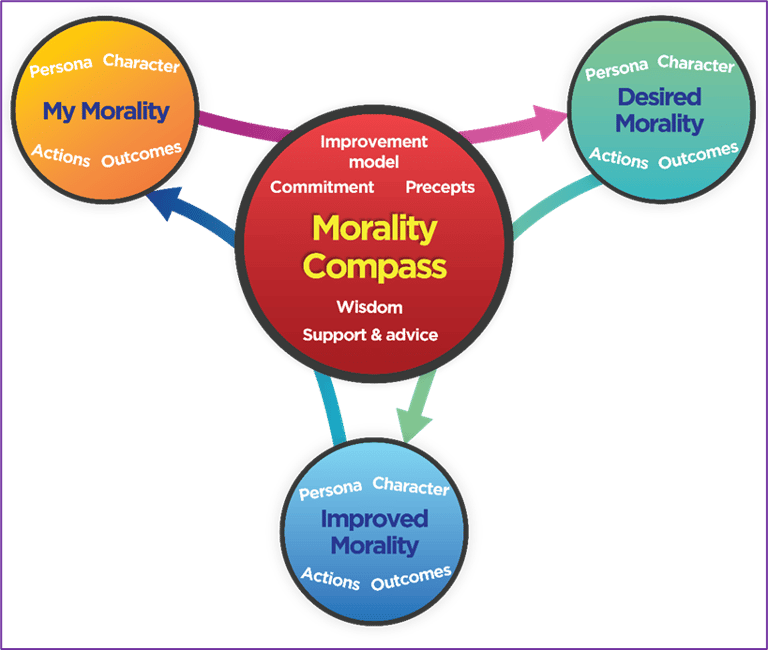
In addition to the linear steps to improvement, the improvement process can be viewed as an ongoing circular action comprising four parts:
Current Morality.
Desired Morality.
Morality Compass.
Improved Morality.
This is depicted in The Morality Improvement Process’ below.
The Morality Improvement Process
This circular process is continually influenced by:
Temptations and influence of vice and corruption.
Application of ‘The Precepts’.
Support and advice received.
Application of our wisdom and commitment.
The ‘Moral Improvement Model,’ (see Part 7 – Reflection) provides a simplified description of what is needed for moral improvement and is expanded in the ‘Moral Compass’ below which depicts moral improvement from a more holistic point of view as influenced by many factors. A more in-depth version of ‘The Moral Compass’ is also provided at Annex B.
The Moral Compass
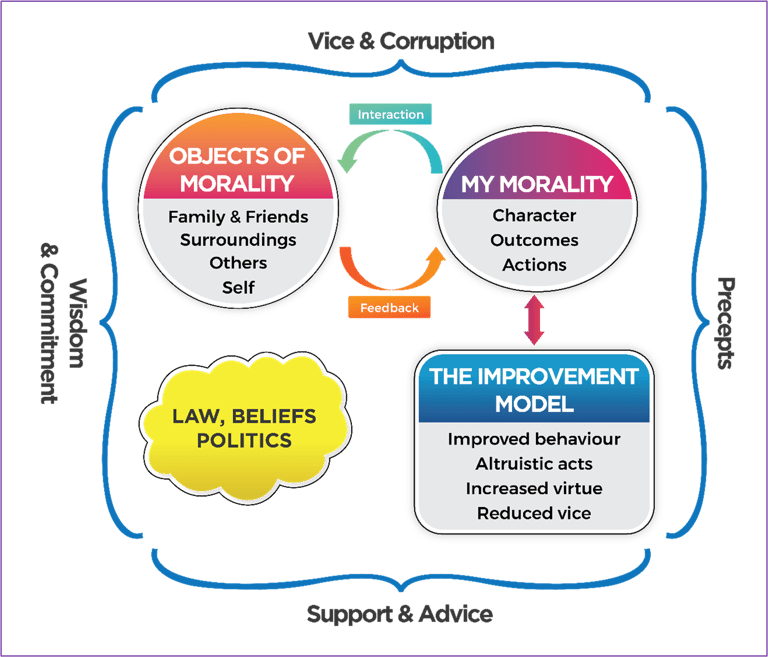
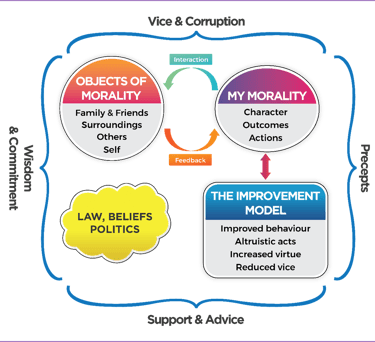
Figure 16 - The Moral Compass
Figure 16 - The Morality Improvement Process